
Views: 0 Author: Site Editor Publish Time: 2026-09-23 Origin: Site


Brand design ambitions often clash violently against harsh manufacturing realities. You might sketch a beautiful, intricate frosted bottle adorned in gold foil. However, the production line often struggles to replicate it at scale. Choosing the wrong finish leads directly to painful production delays. It causes massive budget overruns. It leaves unappealing, scuffed bottles sitting on retail shelves. The core challenge lies in balancing aesthetic dreams and practical engineering constraints. We want to solve this friction today.
This guide provides a pragmatic, evaluation-driven framework. We will help you select custom glass bottle decoration methods effectively. You will learn to align these choices tightly to product positioning and supply chain realities. Every decision impacts your unit economics and long-term viability. We will explore core methods, essential test requirements, and crucial handling constraints. By the end, you will navigate the procurement process confidently. You can ensure your finished glass packaging looks stunning and performs flawlessly under pressure.
Decoration choices must be evaluated against production volume (MOQ), unit cost margins, and supply chain friction (transit scuffing).
High-end finishes like hot stamping or metallization require rigorous compatibility checks with your specific glass bottle and jar product range.
Long-term brand credibility relies on mandatory glass container quality testing to ensure decoration adhesion and chemical resistance.
The optimal decision balances aesthetic impact with scalable, repeatable manufacturing processes.
We often see brands rush straight into decoration design. They skip the vital step of mapping out hard constraints first. You must evaluate four critical pillars before committing to any surface finish. If you ignore these pillars, you risk costly mid-production pivots.
First, look closely at unit economics versus perceived value. You need to map the exact cost-per-unit of a decoration. Compare it directly against your final retail price point. A complex, multi-pass print job makes perfect sense for a $150 luxury perfume. However, it completely destroys the profit margin on a $5 beverage. You must justify every additional cent spent on aesthetic upgrades.
Next, assess your production scalability. Minimum Order Quantities (MOQs) dictate your entire inventory flow. Some specialized finishes demand massive runs to offset expensive tooling costs. Evaluate how these high MOQs and long lead times impact your demand forecasting. Ask yourself if your cash flow supports holding large volumes of pre-decorated glass.
Then, confront friction and handling realities. Think about how the bottle moves throughout its lifecycle. It rattles violently on high-speed filling lines. It rubs against cardboard dividers during transit. The end-user grips it forcefully with wet or oily hands. You must choose a finish durable enough for this specific journey. Consider these handling touchpoints:
Filling Line Speeds: High-speed automation requires robust, scuff-resistant surfaces.
Transit Conditions: Vibrations during shipping easily wear down fragile coatings.
Consumer Usage: Daily handling in humid environments tests ink adhesion daily.
Finally, weigh sustainability and compliance factors. Brand environmental goals matter deeply to modern consumers. Consider utilizing eco-friendly organic inks. Look actively at recyclable coatings. Ensure your chosen method does not render the entire glass vessel unrecyclable. Balance these four pillars early. You will save enormous amounts of time and capital later.
Manufacturers offer numerous ways to alter raw glass. We will break down the four most common industrial methods. Understanding their strengths and limitations helps you match the process to your design.
Screen printing forces ink through a fine mesh stencil directly onto the glass surface. The factory then cures the ink using UV light or extreme heat. This method dominates the industry for good reason. It delivers excellent durability and vibrant color saturation.
Best for: High-volume, bold, durable, single- or bi-color designs. It works beautifully for minimalist typography and solid brand logos. Ceramic inks baked at high temperatures offer near-permanent adhesion.
Limitations: Screen printing struggles heavily with fine gradients or photographic images. High setup costs make it economically unviable for short runs. Registering multiple colors requires multiple passes, which increases the scrap rate.
Spray coating atomizes liquid paint or polymer over the glass. Factories use it to create frosted, matte, glossy, or custom Pantone color finishes. It transforms clear flint glass into entirely new visual materials.
Best for: Full-coverage branding and creating unique tactile experiences. It provides excellent UV protection for light-sensitive liquids like beer, olive oil, or delicate cosmetic serums. It feels premium in the hand.
Limitations: The surface remains vulnerable to scratching if not cured properly. If you want a clear window on a frosted bottle, a worker or machine must mask that specific area before spraying. Masking specific areas drastically increases labor costs.
Hot stamping applies a metallic foil to the glass using heat and pressure. It requires custom metal dies. This process creates a brilliant, reflective metallic finish impossible to achieve with standard inks.
Best for: Premiumization in cosmetics and high-end spirits. It creates stunning metallic, high-contrast accents. Brands use it to signal luxury and exclusivity on retail shelves.
Limitations: High tooling costs present a major barrier to entry. Hot stamping requires perfectly flat or strictly cylindrical surfaces for precise application. Complex curves cause the foil to wrinkle and tear.
Workers apply printed water-slide decals manually to the glass surface. The bottles then enter a lehr oven. The heat burns away the decal backing and fuses the artwork into the glass.
Best for: Complex, multi-color artwork or irregular bottle shapes. It solves problems when machines cannot easily print on strange angles. It handles intricate illustrations flawlessly.
Limitations: It remains a highly labor-intensive application. This drives up the cost-per-unit significantly. It requires very careful baking and quality control to ensure long-term durability.
Summary of Core Decoration Capabilities
Decoration Method | Visual Strengths | Primary Engineering Limitation |
|---|---|---|
Screen Printing | Bold colors, crisp text, high opacity | Cannot render gradients; high setup costs |
Spray Coating | Tactile matte/frost, 100% coverage | Susceptible to abrasion; masking is expensive |
Hot Stamping | Brilliant metallic reflection | Requires flat/cylindrical surfaces; high tooling |
Decal Application | Unlimited colors, photographic detail | Slow manual application; high unit cost |
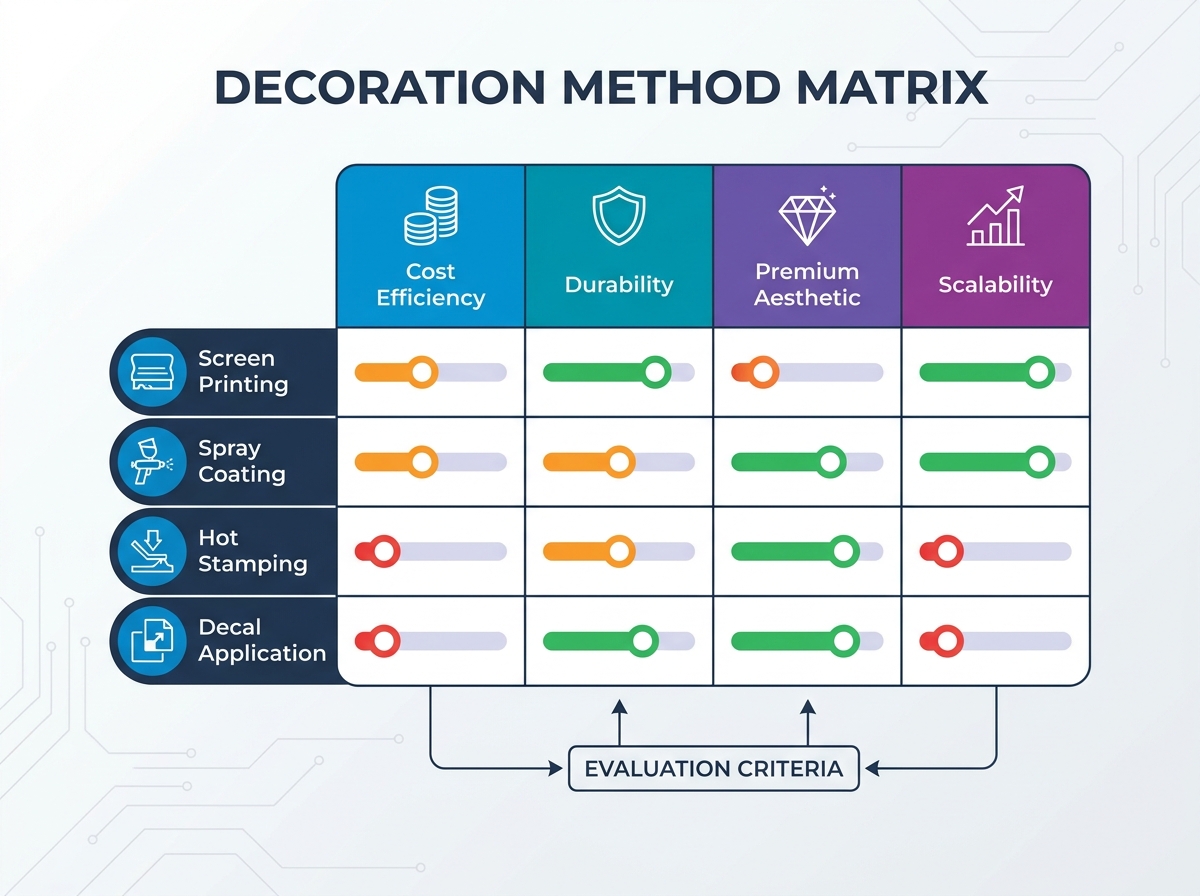
You cannot design decoration in a vacuum. The specific industry dictates the performance requirements of the glass. You must match the finish directly to the environmental realities of your chosen glass bottle and jar product range. Different contents demand different survival characteristics.
Spirits & Beverage:
This sector operates in harsh physical environments. You must prioritize moisture resistance. Premium vodka bottles often sit submerged in ice buckets for hours. The ink cannot slide off. Furthermore, beverage brands rely on high-speed filling lines. The decoration must survive metal guides and rapid bottle-to-bottle impacts. Screen printing with ceramic inks usually serves this category best.
Fragrance & Cosmetics:
Perfumes present a unique chemical challenge. You are bottling highly concentrated alcohol and essential oils. Focus heavily on chemical resistance. A single drop of perfume on the exterior can strip cheap ink instantly. This sector also demands premium tactile finishes. Metallization and fine frosting dominate here. Consumers associate the heavy weight and precise texture with luxury.
Food & Pantry Jars:
Food packaging faces strict regulatory scrutiny. You must emphasize regulatory-compliant inks. Many food products undergo pasteurization after filling. The jar, along with its decoration, must survive boiling water baths. You also need excellent label-area integration. Spray coatings must leave a clean window so paper labels adhere properly.
Strategic Advice: Do not finalize a decoration method until the physical shape and weight of your target glass range are locked in. The physical shape strictly limits machine capabilities. A beautiful hot-stamp foil design becomes entirely useless if you suddenly switch from a cylindrical bottle to a tapered flask.
Beautiful designs mean nothing if they fall apart before reaching the consumer. Rigorous laboratory evaluation bridges the gap between a design concept and a reliable product. Mandatory testing prevents catastrophic brand damage. You must demand your manufacturing partner perform comprehensive validation.
Adhesion Testing (Cross-Hatch Test):
This test ensures inks and foils do not flake or peel under consumer use. Technicians cut a precise grid pattern into the decorated surface. They apply a specialized industrial tape over the grid. Then, they rip the tape off rapidly. If chunks of ink pull away, the curing process failed. This simple test exposes weak molecular bonds immediately.
Scuff & Abrasion Resistance:
Bottles rub together endlessly during global shipping. This test simulates transport vibrations to verify the finish will survive carton friction without degrading. Technicians place sample bottles on a vibratory table. They let them shake against cardboard and partitions for hours. If the matte coating rubs off, you need stronger polymer agents.
Chemical Compatibility:
You must test the exterior decoration against the internal liquid. Technicians intentionally spill the bulk product (like perfume or high-proof alcohol) directly onto the printed surface. They let it sit for 24 to 48 hours. The decoration fails if the ink smears, bubbles, or loses its gloss.
Thermal Shock & Moisture Tests:
Glass transitions through varying climates. This validates that custom finishes won't crack or wash off under extreme temperature changes or heavy condensation. Bottles move from freezing cargo holds to humid warehouses. We plunge decorated samples into hot water, then immediately into ice water. Surviving this thermal shock guarantees structural integrity.
Transitioning from a digital render to mass production introduces significant risk. A structured procurement approach keeps suppliers accountable. It keeps your timeline intact. Follow this sequential checklist to manage the manufacturing handover.
Requesting Prototypes (Pre-Production Samples):
You must demand physical samples rather than relying solely on 3D digital renders. A computer screen cannot accurately display tactile friction or exact color matching under retail lighting. Holding the physical prototype reveals weight imbalances and texture flaws instantly. Never sign a mass-production contract without approving a physical master sample.
Reviewing the Tolerance Spec Sheet:
Perfect consistency does not exist in mass manufacturing. Understanding acceptable variance remains crucial. The tolerance spec sheet defines how much color registration and print placement can drift. For example, it dictates if a logo can sit 1mm off-center. Agree on these measurable boundaries early. It prevents arguments over rejected batches later.
Auditing the Decorator's Capabilities:
You need to confirm whether your glass manufacturer handles decoration in-house or outsources it to a third party. In-house facilities offer tighter quality control and faster feedback loops. Outsourcing often creates a finger-pointing dynamic. If a bottle arrives broken, the glassmaker blames the decorator, and the decorator blames the glassmaker. Clarify this chain of custody immediately to protect your lead times.
Successful custom glass decoration represents a complex engineering decision, not just a simple design choice. You must balance visual ambition against hard physical limits. Start by locking in your exact unit economics and defining your supply chain friction points. Choose a method that aligns with your product category realities, whether that involves high-speed beverage lines or corrosive cosmetic liquids.
We cannot emphasize enough the importance of bridging the gap between aesthetic vision and supply chain viability through rigorous laboratory testing. Do not skip the cross-hatch or thermal shock tests. Demand physical prototypes and establish clear tolerance boundaries before mass production begins.
If you feel overwhelmed by these technical choices, take action today. Request a technical consultation with an experienced manufacturing partner. Download a comprehensive sample checklist to guide your next supplier meeting. Alternatively, review an established catalog of compatible glass finishes to see what proven combinations look like in the real world.
A: Screen printing and automated spray coating offer the most cost-effective solutions for large runs. Once the factory covers the initial tooling and setup costs, the per-unit price drops dramatically. They rely on high-speed automation. This economy of scale makes them ideal for mass-market beverage and food brands.
A: Developing a fully realized prototype typically takes between 2 to 4 weeks. The timeline depends heavily on tooling requirements. A simple one-color screen print moves quickly. However, custom hot stamping requires machining specialized metal dies, which extends the lead time significantly.
A: Yes, but it depends on the specific finish. Organic and eco-friendly inks burn off easily during the glass recycling melting process. However, heavy metallization or thick epoxy spray coatings can contaminate the recycling stream. Always consult your manufacturer about the recyclability of specific polymer coatings.
A: Ink chipping usually points back to a lack of proper glass container quality testing. It often stems from incorrect curing temperatures or using inks incompatible with the specific glass substrate. Bypassing mandatory adhesion tests allows these fatal flaws to reach the consumer.