
Views: 0 Author: Site Editor Publish Time: 2026-09-02 Origin: Site


Formulating a high-efficacy skincare serum is only half the battle. You spend months perfecting a volatile vitamin C or a delicate peptide blend. However, the packaging serves as your ultimate safeguard. If the packaging fails, active ingredients rapidly oxidize. Bottles might leak in transit. Consequently, your brand reputation inevitably suffers. Selecting the right packaging requires delicate balancing. You must match formula compatibility with precise dispensing. You also need premium aesthetics while ensuring supply chain reliability. This guide breaks down the technical criteria for evaluating dropper packaging. We cover commercial aspects for liquid skincare lines as well. You will explore complex material choices. You will learn how to protect light-sensitive ingredients. We also discuss implementing rigorous testing protocols. Ultimately, you will gain the knowledge needed to launch serums safely and beautifully.
Material matters: Match bulb materials (Silicone, NBR, TPR) to your formula’s chemical profile to prevent degradation and contamination.
Light and air protection: High-potency ingredients require specific glass tints and precise thread sealing to prevent rapid oxidation.
Cohesive branding: Strategic customizations (frosting, silk screening) elevate perceived value and allow seamless integration across wider product lines.
Rigorous testing: Never skip the 8-to-12-week compatibility and vacuum leak testing phase before committing to mass production.
You must start your packaging journey with a baseline evaluation. Assessing product viscosity is paramount. Manufacturers engineer droppers specifically for low-to-medium viscosity liquids. These include water-based serums, oil-based blends, and gel-like formulations. If your product is too thick, it will not travel up the pipette. If it is too thin, it might drip prematurely.
When selecting a dispensing mechanism, brands often weigh droppers against airless pumps. Each system serves a distinctly different formulation need. Airless pumps suit extreme zero-oxidation requirements. They handle highly viscous creams exceptionally well. However, they often lack a premium tactile experience. Consumers usually expect a luxurious feel from high-end skincare.
Conversely, glass dropper bottles provide a highly ritualistic user experience. They allow for precise, drop-by-drop dosage control. This precision proves essential for potent active ingredients. Furthermore, glass ensures complete chemical inertness. It does not react with aggressive actives. For example, high-concentration Alpha Hydroxy Acids (AHAs) and pure Vitamin C remain stable inside glass vessels.
The industry verdict remains clear. Glass droppers stand as the gold standard for serum packaging. They offer an unmatched balance of chemical stability and sustainability. They also deliver the perceived luxury that skincare consumers demand.
Understanding the anatomy of a dropper prevents costly formulation failures. A dropper is not a single unit. It is a complex assembly of glass, rubber, and plastic. Each component requires careful evaluation.
Cosmetic chemists generally categorize glass into distinct grades. Type I, known as Borosilicate glass, offers superior thermal resistance. It also provides unmatched chemical durability. You should choose Type I for highly volatile formulations. Medical-grade serums also benefit from this material. However, it comes at a higher production cost.
Type III glass, or Soda-Lime glass, serves as the cosmetic industry standard. It is highly durable and cost-effective. It is also fully recyclable. For most commercial skincare lines, Type III glass performs exceptionally well. It protects standard water and oil emulsions without issue.
Table 1: Cosmetic Glass Type Comparison
Glass Grade | Material Composition | Best Use Cases | Cost Profile |
|---|---|---|---|
Type I | Borosilicate | Volatile actives, medical-grade serums | High |
Type III | Soda-Lime | Standard serums, facial oils, daily skincare | Low to Medium |
The rubber bulb is often the weakest link in dropper packaging. You must match the bulb material to your liquid. Silicone offers excellent temperature resistance. It provides a highly premium, soft-touch feel. However, silicone can swell or degrade. This happens when you expose it to certain essential oils or silicone-based serums.
NBR (Nitrile Butadiene Rubber) boasts high chemical resistance. It stands as the safest choice for oil-based formulations. It handles aggressive ingredients well. If your serum contains heavy botanical oils, always specify NBR bulbs.
TPR (Thermoplastic Rubber) represents a reliable middle ground. It is cost-effective and recyclable. Manufacturers frequently use TPR for standard, water-based serums. It performs adequately unless introduced to harsh solvents.
The glass pipette dictates the actual dispensing experience. You can choose between several distinct shapes. A pointed tip provides precision targeting. This works perfectly for spot treatments. A round tip delivers a standard, uniform drop. It suits daily facial serums. A bent tip allows for angled dispensing. It helps users extract product from the very bottom of the bottle.
Always verify the pipette length. It must reach precisely to the bottom of the bottle. This minimizes product waste. However, it must not strike the base during closure. If it hits the bottom, the glass can shatter during transit.
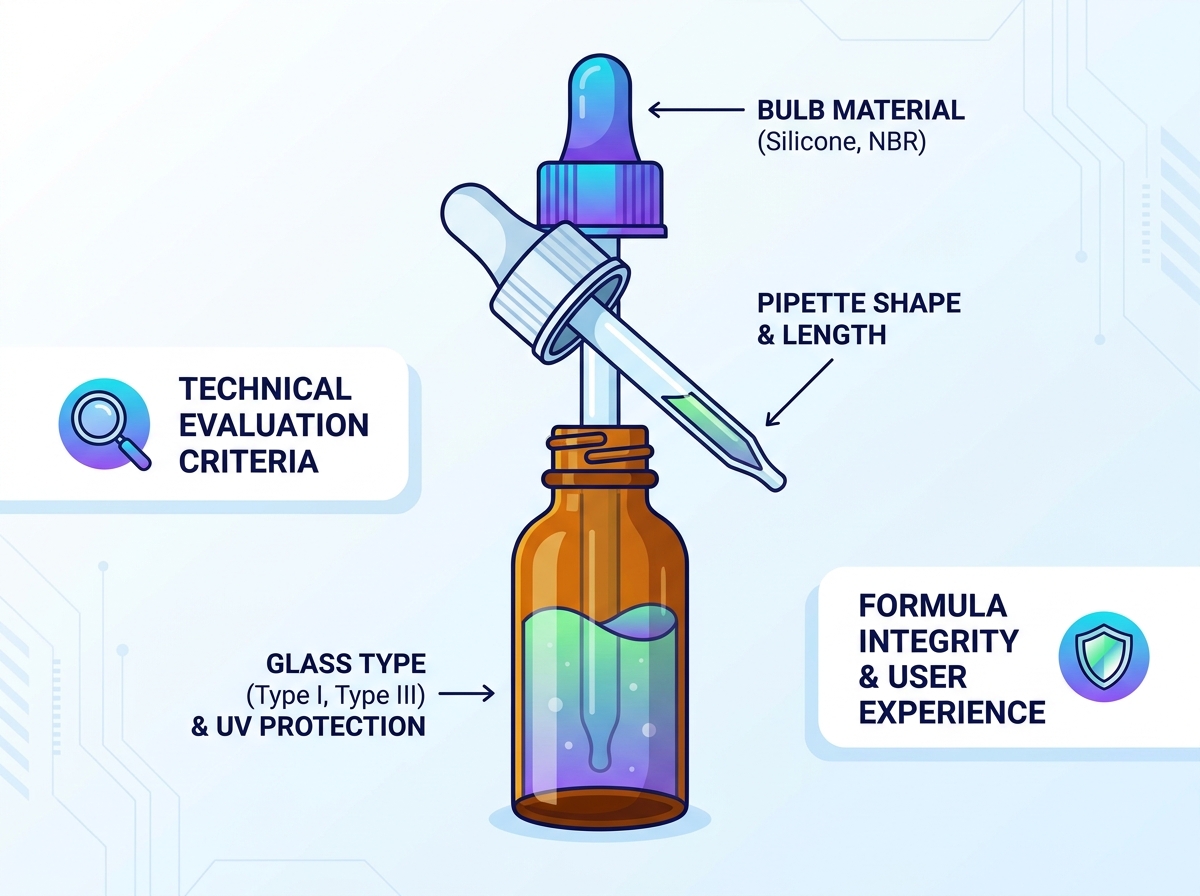
Active ingredients degrade quickly when exposed to environmental stressors. Your packaging must act as an impenetrable barrier. You cannot compromise on photo-stability or sealing integrity.
UV protection is mandatory for potent formulas. Clear glass looks beautiful on a shelf. However, it is only suitable for completely stable formulations. Light-sensitive ingredients, such as Retinol and Vitamin C, require heavy shielding. For these actives, amber glass is the traditional choice. Cobalt blue or opaque UV-coated glass also works exceptionally well. These tints prevent rapid oxidation and preserve product efficacy.
Thread alignment causes the most frequent packaging failures. A mismatched neck finish spells disaster. For instance, pairing an 18/415 neck with a poorly toleranced closure guarantees leakage. You must ensure absolute sealing integrity. We recommend following these critical steps:
Verify the exact neck finish dimensions of both the bottle and the collar.
Request vacuum leak test reports from your packaging suppliers.
Ensure the closure system withstands pressure changes during air freight shipping.
Conduct manual torque testing to check how much force breaks the seal.
Additionally, regional cosmetic safety compliance often dictates specific closures. You must evaluate closures with child-resistant features if your formula demands it. Push-and-turn mechanisms prevent accidental ingestion. Tamper-evident drop-rings assure consumers that the product remains untouched since manufacturing.
In a saturated skincare market, standard stock bottles simply blend in. Consumers judge a product's efficacy partly by its external appearance. Utilizing custom cosmetic glass packaging creates a proprietary brand asset. Custom molds establish a unique silhouette. Gradients and distinct profiles make your serum instantly recognizable.
Surface treatments offer another layer of brand differentiation. Frosting diffuses light beautifully. Matte finishes convey a clinical, clean-beauty aesthetic. They feel premium to the touch. When it comes to branding, avoid cheap adhesive labels. Silk-screen printing is much more durable. Hot stamping adds luxurious metallic accents. Both methods resist ink degradation from accidental oil drips.
Portfolio cohesion represents the final piece of the branding puzzle. A standalone serum bottle looks nice. However, a unified product line builds brand trust. Ensure your chosen supplier can match finishes and colors across your entire catalog. Your serum bottles should share a design language with your cream jars for cosmetic packaging, toners, and cleansers. This consistency guarantees a seamless, premium unboxing experience for the consumer.
Choosing the right manufacturing partner mitigates severe launch delays. Do not simply trust digital catalogs. A 3D rendering cannot reveal a faulty thread.
You must request prototyping and physical samples. Once they arrive, evaluate them thoroughly. Check the tactile feel of the rubber bulb. Test the smoothness of the screw thread. Examine the clarity and weight of the glass base. If the bottle feels flimsy, your customers will notice.
Never skip mandatory compatibility testing. This is a common mistake among emerging brands. You must fill the sample packaging with your exact formulation. Then, subject these samples to rigorous stress tests. A proper testing protocol includes:
Extreme temperature cycling (accelerated aging) over an 8-to-12-week period.
Direct light exposure to monitor formula color shifts.
Physical drop tests to simulate shipping impacts.
Daily visual checks for bulb swelling, ink flaking, or liquid seeping.
Finally, assess your supplier's commercial capabilities. Verify their Minimum Order Quantities (MOQs) for both custom and stock items. Audit their defect rate allowances. Request their quality control (QC) certifications, such as ISO 9001. You must also confirm accurate lead times. Include buffer time for custom tooling if applicable. This ensures perfect alignment with your product launch roadmap.
Sourcing the correct glass dropper bottles requires looking far past aesthetic appeal. It demands a rigorous evaluation of chemical compatibility. You must prioritize closure integrity and robust UV protection. The wrong material choice ruins potent actives, while the right design elevates your brand.
Your next steps are clear and actionable. First, audit your formula's viscosity and chemical aggressiveness. Second, order blank samples of different bulb and glass combinations. Finally, initiate your internal compatibility testing phase before exploring expensive cosmetic customizations. Taking these steps guarantees a successful, leak-free product launch.
A: Standard industry practice requires 8 to 12 weeks of accelerated testing at various temperatures (usually 4°C, 25°C, and 45°C) to accurately observe any interactions between the formula, the glass, and the rubber bulb.
A: This is typically caused by a chemical mismatch. Oil-based serums or formulas heavy in essential oils can cause silicone bulbs to swell or melt. Switching to an NBR (Nitrile) bulb usually resolves this issue.
A: Common cosmetic neck finishes include 18/400, 18/415, and 20/400. It is critical that the bottle's neck finish exactly matches the closure to guarantee an airtight seal.
A: The glass bottle itself is highly recyclable. However, the closure is often a mixed-material component (plastic collar, rubber bulb, glass pipette). Look for suppliers offering mono-material closures or easily disassembled parts to improve end-user recyclability.