
Views: 0 Author: Site Editor Publish Time: 2026-09-16 Origin: Site


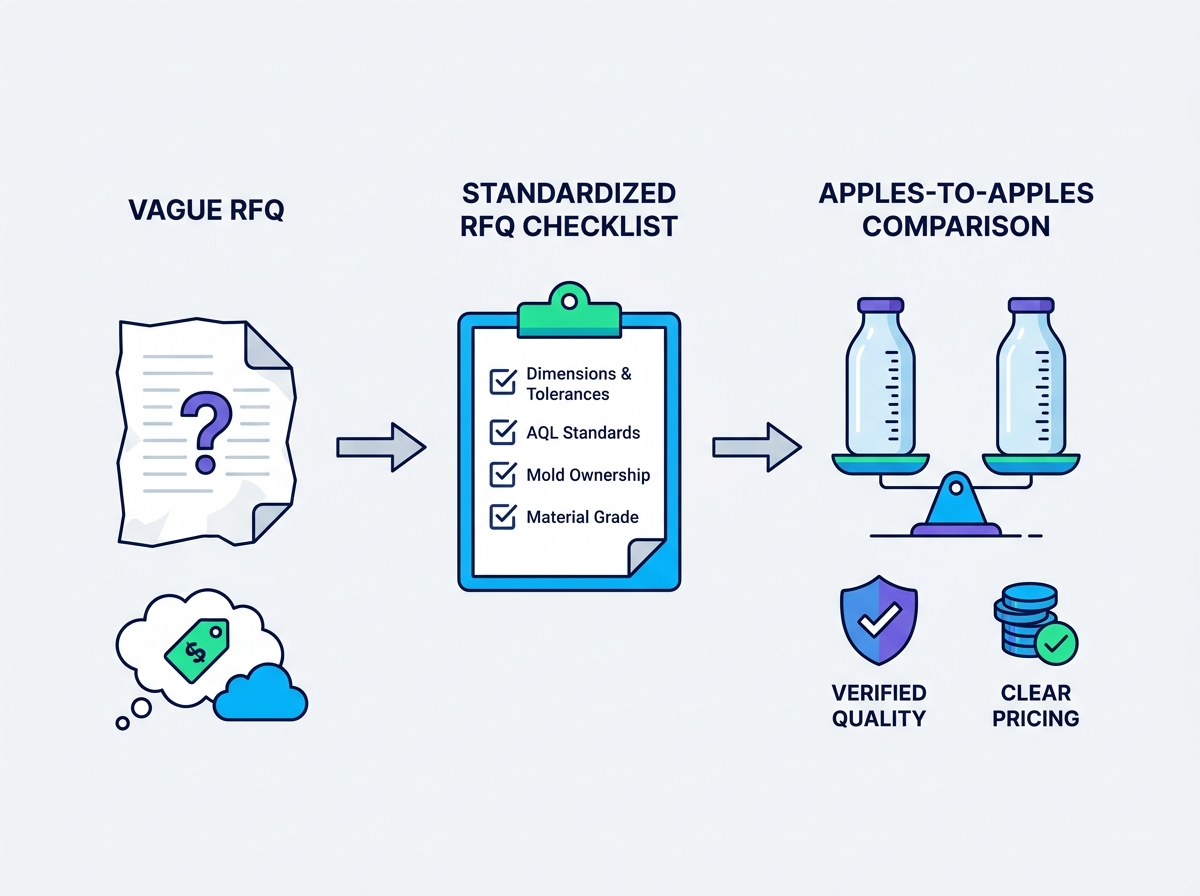
Procuring packaging often feels like navigating a minefield of hidden costs. Vague Requests for Quotation (RFQs) routinely lead to inflated pricing. They also cause unexpected tooling fees and severe production delays. When you leave specifications open to interpretation, suppliers quote inconsistently. You end up comparing completely different production standards.
A rigid, standardized specification changes this dynamic. It forces suppliers to quote apples-to-apples. This rigorous approach exposes unqualified manufacturers early in the evaluation process. You can quickly filter out vendors lacking the necessary technical capabilities.
We built this comprehensive, engineering-aligned checklist for procurement teams. Below, you will learn how to structure RFQs for custom glass bottles effectively. By following these parameters, you minimize operational risk. You also accelerate your sourcing timeline and ensure seamless production runs.
Drafting a technical specification requires absolute precision. Small calculation errors often cause massive production failures down the line. You must document every physical attribute clearly.
You must define both nominal capacity and brimful capacity. Nominal capacity refers to the target fill point. Brimful capacity measures the absolute maximum volume before overflow. Outline these numbers in milliliters (ml) or fluid ounces (oz).
Next, specify your target glass weight. You should also state the acceptable weight variance. Heavy glass implies premium quality. However, excessive weight increases shipping expenses. If the glass weight falls too low, you risk weak sidewalls. Thin sidewalls shatter easily on high-speed filling lines.
List exact dimensional requirements. Detail the overall height, body diameter, and base width. If your bottle has a flat label panel, specify the flatness tolerance. Automated labeling machinery requires perfectly flat surfaces.
Mandate strict tolerances for every dimension. Glass naturally shrinks as it cools. If you do not specify allowed variances (usually +/- 1mm to 2mm depending on size), closures might not fit. Furthermore, odd shapes might jam your conveyor belts.
A secure seal protects your product from oxidation and leaks. Specify the exact neck finish standard in your RFQ. Common industry standards include Glass Packaging Institute (GPI) thread profiles, Roll-on Pilfer Proof (RoPP), or cork mouth finishes. Mention the exact finish number, such as GPI 400-28. This guarantees hermetic seals and complete closure compatibility.
State the required glass type clearly. Different products require different light protection and aesthetic appeal. If your company enforces sustainability mandates, list the required cullet (recycled glass) percentages.
Table 1: Common Glass Material Grades
| Glass Grade | Primary Characteristic | Best Use Case |
|---|---|---|
| Super Flint | Exceptional clarity, ultra-low iron content | Premium spirits, high-end cosmetics |
| Extra Flint | High clarity, standard iron levels | Gourmet foods, standard liquors |
| Amber | Blocks UV light efficiently | Beer, pharmaceuticals, light-sensitive oils |
| Emerald Green | Distinctive aesthetic, moderate UV protection | Wine, olive oil, mineral water |
Understanding tooling and volume requirements prevents budget overruns. You need transparent pricing models before signing any agreements.
Custom packaging requires custom molds. Require your suppliers to itemize their tooling costs. Ask them to separate the pricing for prototype molds versus full production molds. Prototype molds use fewer cavities. They cost less and allow physical testing.
Explicitly state the terms for intellectual property and mold ownership post-production. You must own the final mold design. Clarify whether you can transfer these molds to another facility later. This protects you from vendor lock-in.
Suppliers optimize their IS (Individual Section) machines for massive runs. Therefore, they often demand high MOQs. Request staggered pricing tiers in your RFQ. Ask them to quote for 50k, 100k, and 250k units. This strategy helps you evaluate long-term unit economics. It reveals how well the manufacturer scales as your brand grows.
Glass furnaces operate continuously. Manufacturers schedule "campaigns" for specific glass colors. Ask vendors for realistic project timelines. Ensure they outline the entire path from concept to delivery.
Standard Production Timeline Phases:
A beautiful design means nothing if the bottles shatter or leak. You must enforce strict glass container quality control protocols early in the negotiation phase.
Mandate a clear Acceptable Quality Level (AQL) standard. This statistical tool dictates how many defects you will accept per batch before rejecting the entire shipment. Define your defect categories explicitly.
Require detailed documentation on testing protocols. Ask vendors to explain their annealing standards. Proper annealing relieves internal stress within the glass. Discuss internal pressure resistance testing. This step proves vital for carbonated beverages. You should also require thermal shock testing protocols. Hot-fill applications or pasteurization processes demand high thermal stability.
Your packaging must meet your target market's legal requirements. Specify the necessary certifications upfront. Request FDA compliance declarations for US markets. Ask for LFGB certifications for European distribution. Mandate heavy metal testing reports (checking for lead or cadmium). This ensures your containers remain entirely safe for food and beverage contact.
Many brands elevate their packaging using secondary decoration. You must outline these requirements clearly to capture accurate costs.
Detail your exact aesthetic requirements. Outline needs for acid frosting, multi-color screen printing, embossing, or debossing. If you use Applied Ceramic Labeling (ACL), specify the color codes. Include artwork positioning tolerances. A slightly misaligned printed logo ruins a premium brand image. Define acceptable margins of error for label placement.
Poor packing decisions destroy margins through transit breakages. Specify exactly how the vendor must pack the finished goods. You can choose bulk palletization. This method uses cardboard tier sheets between bottle layers, wrapped in thick shrink film. It suits high-speed automated bottling lines.
Alternatively, request printed reshipper cartons. The manufacturer packs empty bottles into custom-branded boxes with dividers. After you fill the products, you reuse the same boxes for retail distribution. Evaluate which option minimizes your landed breakage rates.
Freight impacts your budget heavily. Clearly state the required delivery terms using standard Incoterms. Common choices include FOB (Free On Board), CIF (Cost, Insurance, and Freight), or DDP (Delivered Duty Paid). Specify your final destination ports or warehouse addresses. This clarity ensures suppliers calculate freight and insurance accurately.
Once you send out your structured RFQ, you will receive multiple bids. You must look beyond the bottom-line price to assess true capability.
Request relevant case studies from every bidder. Ask to see physical samples from their existing glass bottle and jar product range. Examine these samples closely. Verify they have successfully produced similar weights, complex shapes, and desired clarity levels. If you need a heavy-base super flint spirits bottle, do not hire a factory that primarily produces thin-walled amber beer bottles. Their furnaces and technical expertise will not align with your goals.
Do not rely on marketing brochures. Ask for official audit reports to validate their operational maturity. Request their ISO 9001 (Quality Management) and ISO 14001 (Environmental Management) certificates. If you manufacture consumables, ask for GFSI-recognized food safety audit reports. These documents prove they maintain consistent, controlled manufacturing environments.
Outline your shortlisting process clearly in the RFQ document. Tell suppliers exactly what happens next. Typical next steps include signing Mutual Non-Disclosure Agreements (NDAs). After that, you will review their initial CAD drawings. Finally, you select the best candidate to move into the prototype mold phase. Transparent processes keep vendors engaged and responsive.
A meticulous RFQ acts as your primary risk-mitigation tool. It directly impacts your bottom line and protects your launch schedule. By forcing suppliers to adhere to strict technical parameters, you eliminate guesswork. You expose hidden fees before they derail your budget.
Procurement teams should prioritize suppliers who engage deeply with the specifications. Look for vendors who respond with detailed technical queries. They prove much safer than those who offer immediate, unquestioned low-cost bids. Quality manufacturers want to understand your exact filling line constraints and aesthetic goals.
Do not leave your packaging success to chance. Start building comprehensive specifications today. Download a structured RFQ template, or contact a specialized engineering team to review your custom bottle concepts before approaching the market.
A: Costs vary based on complexity and cavity count. A pilot or sample mold generally ranges from $1,500 to $3,500. A full multi-cavity IS machine production mold set typically costs between $5,000 and $15,000. Intricate embossing or unique shapes push prices toward the higher end of these ranges.
A: The entire process usually takes 12 to 16 weeks. Design approval takes 1-2 weeks. Prototype sampling requires 3-4 weeks. After sample approval, cutting mass production molds takes about 4 weeks. Finally, mass production and quality control consume another 4-6 weeks, excluding ocean transit time.
A: In standard industry practice, you own the mold once you pay the tooling fees in full. You should secure exclusivity rights, preventing the factory from selling your design to competitors. However, transferring molds to different factories is often difficult due to differing IS machine specifications.
A: Flint glass offers standard clarity suitable for everyday foods and beverages. Super Flint glass undergoes a specialized process to remove iron content. This creates exceptional, crystal-like clarity and brilliance. Super Flint costs more and is typically reserved for premium spirits, perfumes, and high-end cosmetics.