
Views: 0 Author: Site Editor Publish Time: 2026-09-09 Origin: Site


A fractional-cent error in closure compatibility can quickly escalate into a manufacturing crisis. Mismatched threads often cause product leakage, costly market recalls, and unexpected production downtime. You must treat neck finishes as critical engineering variables rather than simple aesthetic choices. Mismatched components compromise your entire product line.
Moving past basic visual appeal allows you to evaluate mechanical and chemical compatibility accurately. Glass expands and contracts differently than plastic during molding. This material behavior demands precise dimensional alignment between the bottle neck and its sealing mechanism. You need a rigorous evaluation process to safeguard product integrity and protect brand reputation.
This guide breaks down standard industry finish dimensions, complex liner chemistry, and advanced dispensing systems. We will evaluate capping machinery limits and custom tooling timelines. You will learn how to match physical specifications to your specific liquid formulation safely.
Understanding a glass finish requires specific measurement terminology. The Glass Packaging Institute (GPI) and Glass Container Manufacturers Institute (GCMI) define standardized dimensions. You must measure these variables accurately to guarantee a secure seal.
Glass tolerances differ significantly from plastic tolerances. Molded glass lacks flexibility. The manufacturing process creates shallower threads compared to injection-molded plastic. Plastic caps can stretch slightly over rigid glass threads, but metal caps cannot. This rigid interaction dictates strict dimensional adherence. You cannot rely on flexible material forgiveness when sealing glass containers.
Suppliers categorize neck finishes using standardized numerical pairings. The first number denotes the nominal 'T' diameter in millimeters. The second number indicates the thread style and height.
High-volume specifications typically include:
A "close enough" match creates massive risks. Forcing a 24-410 closure onto a 24-400 glass finish causes improper seating. The cap bottoms out before the inner liner compresses. This failed compression guarantees liquid leakage during transit. You must verify both numbers match exactly before ordering bulk inventory.
Continuous thread (CT) caps dominate the packaging landscape. You can source them in metal or rigid plastic materials. Metal caps, typically made from aluminum or tinplate, offer excellent visual appeal and durability. However, they lack flexibility. Rigid plastics like Polypropylene (PP) or Phenolic resin provide better chemical resistance.
Different industries favor specific CT cap materials. Food manufacturers often choose tinplate for vacuum sealing. Pharmaceutical companies prefer ribbed PP caps for better grip and chemical inertness. Premium cosmetic brands lean toward sleek, smooth-walled aluminum caps. Your choice directly influences both user experience and formula stability.
Lug closures use intermittent metal tabs instead of continuous threads. They lock into place using a quick partial turn. Manufacturers primarily use lug caps for food products requiring a vacuum seal.
You must evaluate hot-fill processing compatibility when using lug caps. The bottling line injects steam before capping. As the product cools, it creates a powerful vacuum. This vacuum pulls the cap down securely. If you fail to match the lug cap accurately to the glass finish, the vacuum seal will fail prematurely.
Integrating glass bottle sprayers and pumps requires complex mechanical evaluation. You must match the closure's engine capacity to the liquid's specific gravity and viscosity. Thick lotions require robust pumps with larger chambers. Thin liquids require fine mist sprayers with specialized atomizers.
Dip tube sizing acts as a frequent failure point. The dip tube must rest perfectly at the punt (the indented bottom) of the glass bottle. If it sits too high, the consumer cannot extract the remaining product. If it sits too long, the tube bows upward. Bowing restricts liquid flow and damages the pump engine. You must demand physical sampling to verify tube length accuracy.
Consumer safety relies on reliable specialty closures. Tamper-evident (TE) closures utilize breakaway bands. The band remains attached to the bottle neck after initial opening. This provides visual proof of product safety.
Child-resistant (CRC) closures use push-and-turn mechanisms. You must ensure your CRC choices meet strict regulatory compliance. The Consumer Product Safety Commission (CPSC) dictates specific testing protocols. Standard glass threads sometimes struggle to engage CRC mechanisms correctly. You must verify dual-motion functionality through independent lab testing.
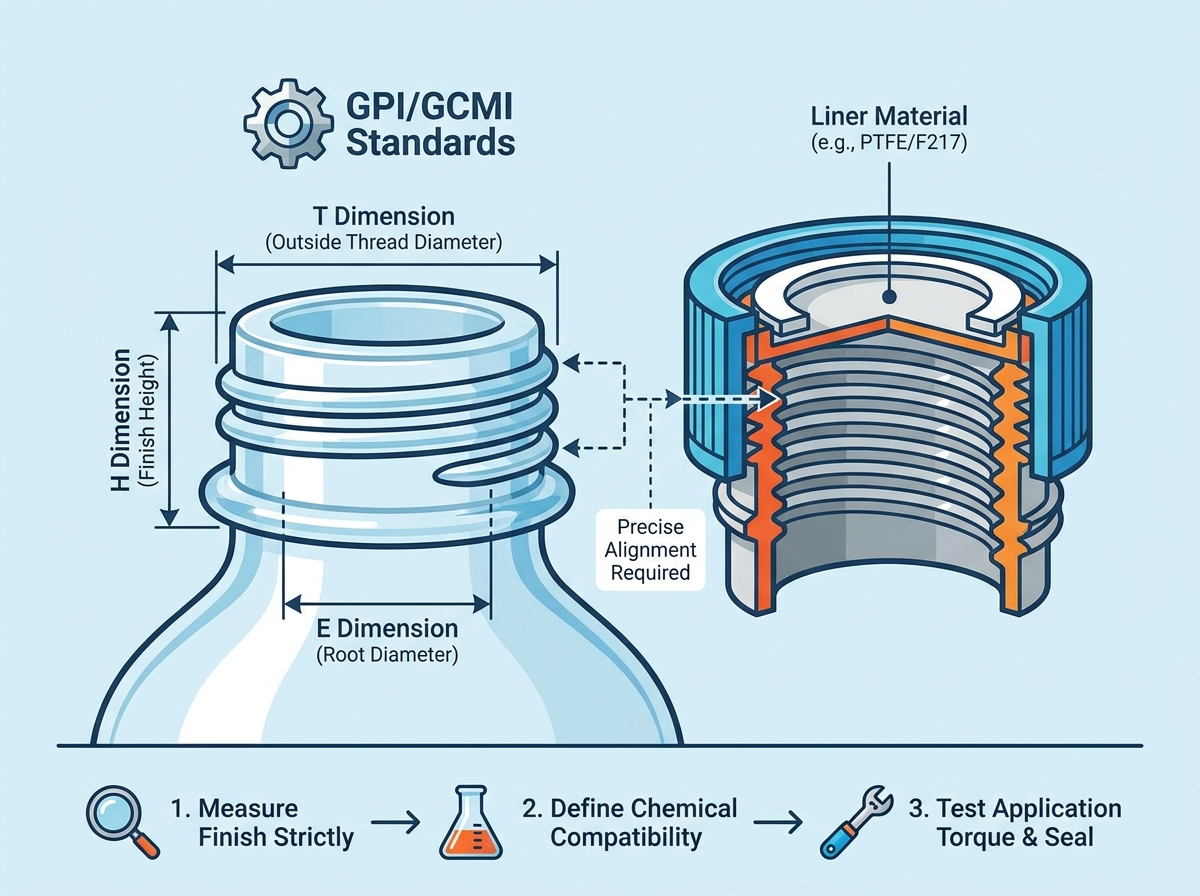
Many buyers falsely blame threads when a bottle leaks. In reality, leakage usually indicates a liner failure. The thread simply applies downward pressure. The liner actually forms the protective seal. If the liner material degrades, cracks, or fails to compress, the product will leak. You must match the liner chemistry to your liquid formula.
Each liner material serves a distinct chemical purpose. Selecting the wrong barrier causes product spoilage or packaging degradation.
Best Practice: Always request material safety data sheets (MSDS) for both your formula and your chosen liner.
| Liner Material | Primary Application | Chemical Resistance | Sealing Method |
|---|---|---|---|
| Plastisol | Hot-Fill Food / Beverage | Low (Non-Aggressive) | Heat / Vacuum |
| PTFE / F217 | Cosmetics / Pharmaceuticals | High | Torque Compression |
| Cone Liners | Essential Oils / Solvents | Very High | Friction / Torque |
| Pressure Sensitive | Dry Goods / Powders | Low | Adhesive / Pressure |
Standardizing your packaging strategy often brings immediate advantages. Using stock glass bottle closures ensures fast speed-to-market. Suppliers hold vast inventories of 400 and 410 series caps.
Stock components also demand much lower Minimum Order Quantities (MOQs). This benefits startups or small-batch production runs. If your product requires standard formulation protection without unique dispensing needs, off-the-shelf caps provide the safest procurement route.
Sometimes, stock components limit brand potential. Evaluating custom bottle closure options makes sense when brand differentiation drives revenue. Proprietary dispensing angles improve user experience for niche cosmetic serums. Unique tactile materials, like embossed metal or wood-grain finishes, elevate premium liquor brands.
Customization also solves engineering challenges. If you design a bespoke glass bottle featuring non-standard neck geometries, you must build a custom cap. Standard closures will fail to seal proprietary thread pitches.
Custom tooling requires significant upfront capital and extended timelines. You must navigate a rigorous prototyping phase. Engineers typically provide 3D printed models first. These models confirm aesthetic proportions but cannot verify sealing mechanics.
Next, you must fund a single-cavity prototype mold. This step produces testing samples. Finally, you invest in multi-cavity production molds. The entire process extends your lead times drastically. Expect an additional 8 to 12 weeks for custom molds. You must balance these delays against the ROI of distinctive branding.
Proper application torque prevents devastating field failures. Torque measures the rotational force applied to the cap. Industry engineers use a standard formula for target torque: it typically equals half the closure diameter measured in inch-pounds.
For example, a 28mm cap requires roughly 14 inch-pounds of application torque. The risks of deviation are severe. Over-torquing strips the plastic threads or cracks the rigid glass finish. Under-torquing causes the cap to back off during transit vibrations. This leads to massive liquid leakage. You must calibrate your machinery daily.
Your closure choice dictates your capping equipment setup. Inline spindle cappers use spinning discs to tighten caps as bottles move down a conveyor. They handle continuous thread caps efficiently. However, they struggle with precise torque control.
Rotary chuck cappers use individual metal chucks to grip and tighten each cap. They offer superior torque accuracy. They excel at applying child-resistant caps and heavy lug closures. Before purchasing components, you must verify your specific cap design runs smoothly on your existing capping machinery.
Never bypass physical testing. You must demand pre-purchase physical samples from your supplier. Run these samples through a rigorous quality assurance checklist.
Closure selection requires rigorous engineering evaluation, not just aesthetic preference. Minor dimensional mismatches compromise product safety and destroy brand trust. You must treat the interaction between glass threads and sealing liners as a precise mechanical system.
To ensure success, follow a strict shortlisting logic. First, measure the glass finish dimensions strictly using calibrated tools. Second, define the necessary chemical compatibility for your internal liner. Third, determine the exact dispensing mechanics required for your viscosity. Finally, test physical samples aggressively on your bottling line before placing bulk orders.
Take immediate action on your next project. Reach out to your packaging supplier and request detailed specification sheets and technical drawings. Order physical closure samples to begin your 30-day stability testing immediately.
A: Use a digital caliper to measure the key dimensions. Measure the 'T' dimension across the outermost threads. Measure the 'H' dimension from the top rim down to the shoulder. Compare these exact millimeter readings against standard GPI charts to identify your finish size.
A: Yes, if the GPI standards match perfectly (e.g., a 28-400 cap on a 28-400 glass finish). However, glass features shallower threads and less flexibility. You must test the thread engagement physically to ensure the plastic cap compresses the liner without bottoming out.
A: Neck leaks usually stem from three common issues. The 'H' dimension might be too short, preventing gasket compression. You may have chosen the wrong gasket material for your liquid. Alternatively, improper application torque might be stripping the threads or leaving the seal loose.
A: No. Standard continuous thread closures are not child-resistant. True child-resistant (CRC) closures require specific two-motion engineering, such as push-and-turn mechanisms. They must also pass certified CPSC testing protocols to legally qualify as child-resistant packaging.